The Quiet Isle
A Feast for CrowsThe Quiet Isle is a prosperous septry on an island in the broadening mouth of the Trident, half a mile from the shore. Its defining significance lies in the contrast between its tranquil religious discipline and the brutal world beyond it: visitors approach through tidal mud and dangerous quicksands, while the community itself receives the wounded, shelters travelers, and preserves a strict culture of prayer, contemplation, and silence.
Setting and Physical Approach
The septry stands upon an upthrust island where the Trident widens toward the Bay of Crabs. Its prosperity is visible from the mainland. Terraced fields cover the slope, fishponds lie below, and a windmill turns above them, its wood-and-sailcloth blades moving in the breeze from the bay. Sheep graze on the hillside, while storks wade around the ferry landing in the shallows.
The island is separated from the shore by water whose character changes with the tide. When Brienne of Tarth, Podrick Payne, and Septon Meribald arrive, the tide is running out swiftly, exposing broad brown mudflats marked by tidal pools. The surface glistens in the afternoon light, but the crossing is not merely a walk across drained water. Meribald warns the travelers to follow his footsteps exactly, because those who choose wrongly may be swallowed by quicksand or drowned when the tide returns.
Saltpans lies across the water to the north, and the brothers of the septry intend to ferry the travelers there on the morning tide. The Quiet Isle therefore functions both as a destination and as an intermediate station: its isolation protects its religious life, yet its position makes it a practical refuge and passage point for people moving through the war-torn riverlands.
Religious Discipline and Silence
Those who live on the island are penitents. They seek to atone for their sins through contemplation, prayer, and silence, making the community’s quiet a deliberate religious practice rather than a consequence of remoteness. Only the Elder Brother and his proctors are permitted to speak freely; the proctors may speak on only one day in every seven.
The silence extends beyond ordinary restraint into a bodily offering. Meribald explains that the silent sisters do not lack tongues, despite the tale told to frighten children. Their silence is a vow of contrition, a sacrifice intended to demonstrate devotion to the Seven Above. The distinction matters: silence is not presented as incapacity, but as chosen discipline. The island’s defining absence of speech is thus an active expression of faith and a visible surrender of ordinary social freedom.
The crossing called the path of faith gives this discipline a physical form. To reach shelter, visitors must trust the Elder Brother’s guidance across unstable ground, placing their feet where he places his. The peril is partly natural and partly moralized by religious language: the faithful are said to cross safely, while the wicked risk being swallowed. The island consequently turns arrival into a small ritual of obedience, requiring strangers to submit themselves to a path they cannot fully judge for themselves.
Refuge, Mercy, and the Hound
The Quiet Isle offers hospitality to Brienne’s party before the travelers continue toward Saltpans. Meribald promises them a hot meal, and the brothers are willing to spare a bone for Dog, the dog accompanying the group. This practical welcome establishes the septry as a place where religious austerity does not exclude care for bodies, animals, or exhausted wayfarers.
The island’s most important act of mercy is disclosed through the Elder Brother’s account of Sandor Clegane. After Sandor was gravely wounded by the poisoned spear of Prince Oberyn Martell, the Elder Brother found him beside the Trident, drawn by his cries of pain. Sandor begged for the gift of mercy, but the Elder Brother was sworn not to kill again. Instead, he bathed Sandor’s fevered brow with river water, gave him wine, and applied a poultice to the wound. These efforts came too late: the Hound died in the Elder Brother’s arms.
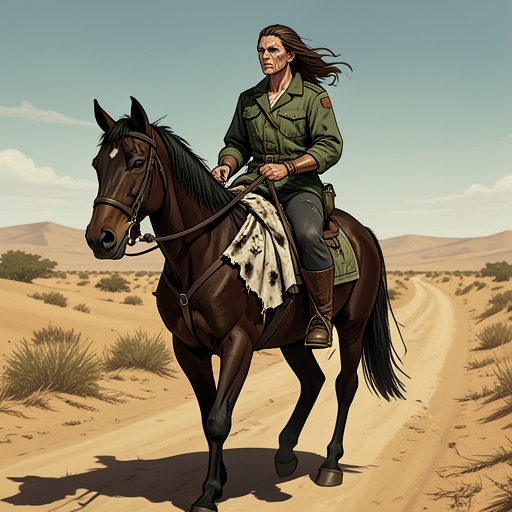
The revelation explains the presence of a huge black stallion in the island’s stables. The horse, formerly known as Stranger, was found beside the river and retained by the brothers. Because the original name seemed blasphemous, they call him Driftwood. Brienne has seen the stallion kicking and understood it only as a dangerous destrier; the Elder Brother’s account gives the animal a human history and confirms that Sandor Clegane is dead, while also placing his final moments within an act of attempted mercy rather than battlefield spectacle.
Threshold Between Violence and Atonement
The Quiet Isle’s geography and customs make it a threshold space. Its residents withdraw from the world through vows of silence, but the island remains connected to the consequences of war through ferries, travelers, wounds, and the dead. The path across the mudflats dramatizes this position: the mainland and the septry are close enough to see one another, yet passage requires care, guidance, and a temporary submission to religious authority.
The Elder Brother’s treatment of Sandor embodies the same transition. Sandor arrives at the end of a violent life, asking for death as relief from suffering; the Elder Brother refuses to become an executioner but does not abandon him. Water, wine, and a poultice replace the sword. The Quiet Isle therefore does not erase violence or restore the dead. Instead, it receives what violence has left behind and subjects it to a different order of meaning, one based on repentance, restraint, and care.
Against the wider struggle for power, the island’s silence also provides a sharp counterpoint. Elsewhere, religious authority is invoked to summon kings, command crowds, or defend political power: Aeron Greyjoy calls the captains of the Iron Islands to a kingsmoot at Old Wyk, while the Faith in King’s Landing acquires knights and confronts the queen. The Quiet Isle presents another model of religious authority. Its power is expressed through seclusion, ritual discipline, hospitality, and the refusal to kill, making the island a rare sanctuary whose influence comes from renunciation rather than command.